Circassians in the United States: Identity in a New World
They number only a few thousand in a country of 330 million, but the Circassian community in the United States has achieved something remarkable: preserving a distinct cultural identity not through geographic concentration, but through deliberate choice and digital-age innovation.
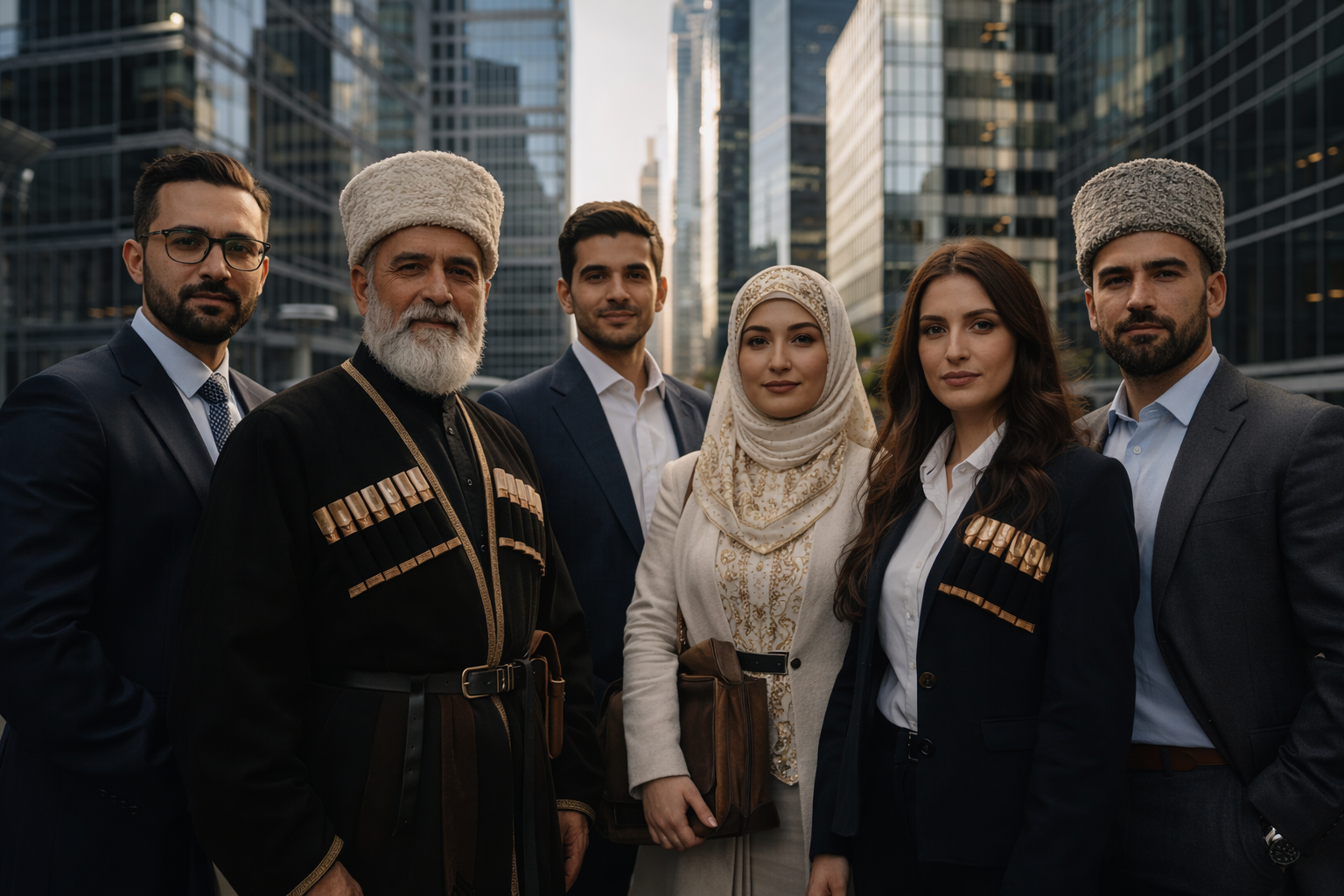
Introduction
The Circassian presence in the United States is not defined by numbers — it is defined by impact, organization, and cultural persistence. In a country of over 330 million people, the estimated 5,000 to 10,000 Circassians living across America have built something remarkable: a diaspora that preserves its identity not through geographic concentration, but through deliberate choice, digital innovation, and an unwavering commitment to heritage.Unlike the older, larger diaspora communities in Turkey and Jordan, where Circassians settled in distinct villages and neighborhoods, the American Circassian community is scattered — from New Jersey to California, from Texas to Michigan. Yet this dispersion has not weakened their identity. If anything, it has made their cultural preservation more intentional, more creative, and more connected to the global diaspora than perhaps any other Circassian community in the world.
The community is concentrated in New Jersey and New York · Organizations like the Circassian Benevolent Association maintain cultural ties · Younger generations balance American identity with heritage preservation · Digital connectivity has strengthened links with global diaspora
How Circassians Came to America
The Circassian migration to the United States occurred in several distinct waves, each shaped by different circumstances and motivations.
- 1900s–1950s — The Early ArrivalsThe earliest Circassians reached American shores as part of broader immigration from the Ottoman Empire. Few in number, many were categorized as "Turkish" or "Syrian" in immigration records — their Circassian identity invisible to broader American society. They settled in the industrial Northeast, maintained identity through family traditions, but lacked critical mass for formal organizations.
- 1950s–1980s — The Cold War EraA second wave of highly educated Circassians from Turkey and the Middle East — engineers, doctors, and academics — saw America as a land of professional advancement. They began the first organized efforts to establish Circassian cultural institutions in the United States.
- 1990s–Present — The Modern WaveThe most significant wave: professionals from Turkey in tech and engineering; academics and students at top universities; Circassian families from Syria after the 2011 civil war; and a smaller number from Adygea, Kabardino-Balkaria, and Karachay-Cherkessia. This wave is uniquely cosmopolitan — bringing together Circassians from different countries, tribes, and backgrounds.

Where Circassians Live in America
Unlike Turkey, where Circassians established over 500 villages, or Jordan where they concentrated in Amman and Zarqa, Circassians in the United States are spread across the country. However, several areas have emerged as centers of Circassian life:
New Jersey — The Heart of the Community
The greater New Jersey area — particularly Wayne, Paterson, and surrounding towns — is home to the largest concentration of Circassians in the United States. This is where the Circassian Cultural Institute was established and where most community events take place. The New Jersey community serves as a cultural anchor for Circassians across the country — families drive hours to attend events here. It is the unofficial capital of Circassian America.
New York City and Surroundings
The broader New York metro attracts Circassian professionals in finance, technology, and the arts. The city's diversity provides a comfortable environment where maintaining a distinct cultural identity feels natural rather than isolating.
California
Southern California and the San Francisco Bay Area host a growing Circassian community, many working in technology and academia. The California community tends to be younger and more digitally active, often leading online cultural preservation initiatives.
Other Communities
Smaller but active Circassian communities exist in Michigan (Detroit area), Texas (Houston and Dallas), Washington D.C. (advocacy and diplomacy), and Florida (growing community of retirees and young professionals).
Community Organizations: The Institutional Backbone
One of the most remarkable aspects of the American Circassian community is its organizational depth. Despite lacking geographic concentration, Circassians in the U.S. have built a network of formal institutions that rivals communities ten times their size.
🏛️ Circassian Benevolent Association (CBA) — Wayne, New Jersey
Founded by Circassian diaspora members who found refuge in America following the Bolshevik Revolution and World Wars, the CBA grew significantly in the late 1960s when ethnic Circassians from Syria joined. The mission: "To study and foster all matters pertaining to the welfare of the Circassians in America in the religious, social, cultural, athletic, and benevolent fields."
Four core pillars:
- Cultural Preservation — Safeguarding Circassian culture, language, and traditions
- Community Engagement — Events, support groups, and unity initiatives
- Outreach & Education — Educating the public about Circassian history
- Youth Empowerment — Investing in the next generation's leadership
The CBA also houses the Narts Dance Ensemble — one of the premier Circassian dance groups outside the Caucasus, invited to perform at the Adigha Khasa's 50th Anniversary in Cologne, Germany.
🎓 Circassian Education Foundation (CEF) — New Jersey
Mission: to promote education, culture, and knowledge to all Circassians in the USA and the world, with special emphasis on inspiring youth toward higher education.
- Awarded scholarships to over 700 college students in 20 years
- Distributed nearly $800,000 in scholarship funds
- Operates with zero paid employees — entirely volunteer-run
- Annual Scholarship Awards & Fundraising Dinner at the Tides Estate, North Haledon, NJ
💻 The Nassip Foundation — North America
A secular organization whose core mission is protecting and promoting the Circassian language, history, and culture through technology and digital media.
- Little Aslan — Children's YouTube series teaching Circassian language through animated content
- OptiLingo — Language learning platform for Circassian accessible globally
- Cultural documentation projects — Recording oral traditions and historical materials before they are lost
🎭 Circassian Cultural Institute (CCI) — New Jersey
- Adyghe language classes for children and adults
- Traditional dance training with professional instructors
- Cultural workshops on Circassian history, crafts, and traditions
- Annual May 21st commemorations (anniversary of the 1864 genocide)
- Community dinners and social events that bridge generations
The Network Effect: What makes American Circassian organizations unique is how they complement rather than compete. The CBA provides the social backbone, the CEF invests in education, the Nassip Foundation handles digital preservation, and the CCI maintains living cultural practices. Together, a young Circassian American can learn their language (CCI/Nassip), receive a college scholarship (CEF), dance in the Narts Ensemble (CBA), and advocate for genocide recognition (Adyghe Khase) — all within the same community network.
Cultural Life: Identity by Choice
What makes the American Circassian experience fundamentally different from other diaspora communities is that identity here is maintained entirely by choice. There are no Circassian villages, no neighborhoods where you hear Adyghe spoken on the streets, no daily environmental reminders of heritage. Every act of cultural preservation is intentional.
Traditional Dance: The Most Visible Expression
Circassian dance remains the most powerful form of cultural expression in the American community. Dance groups perform at community events, weddings, multicultural festivals, and May 21st commemorations. For many young Circassians born in America, learning to dance is their first tangible connection to heritage. As one young dancer from California described it: "I truly felt Circassian the first time I danced. It wasn't something I read about — it was something I felt in my body."
Language Preservation: The Greatest Challenge
The Adyghe language faces its greatest challenge in the American diaspora. Without schools, media, or a surrounding community that speaks the language, maintaining fluency across generations requires extraordinary effort. Families employ several strategies:
- The "Home Language" rule — Some families insist on speaking only Adyghe at home. One New Jersey family made a pact: "Inside the house, we only speak Adyghe." Result: bilingual children.
- Online language courses — Digital platforms connect American Circassian children with teachers in the Caucasus
- Weekend schools — Community organizations run Adyghe classes on weekends
- Family visits — Regular trips to Turkey, Jordan, or the Caucasus expose children to Adyghe-speaking environments

Circassian Weddings in America
Circassian weddings in the United States are remarkable cultural events blending American practicality with deep Adyghe tradition: traditional dance circles (Qafa, Wij, and Islamey), the Pshina (accordion) music, Xabze protocols including the themateh (master of ceremonies), and multi-generational participation. These weddings often draw Circassians from across the country, serving as informal community reunions that reinforce cultural bonds.
Digital Leadership: The American Innovation
Perhaps the most distinctive contribution of the American Circassian community to the global diaspora is its leadership in digital preservation and connection.
Family Tree Platforms
American Circassians have been at the forefront of building digital family tree platforms. One young Circassian in California used such a platform to discover relatives across three countries, building a family tree connecting generations separated by exile. "Technology is rebuilding what exile once broke," he reflected.
Online Archives and Digital Libraries
American Circassians have contributed to the digitization of Ottoman-era settlement records, historical photographs, academic research, and oral history recordings from elderly community members — preserving knowledge that would otherwise be lost within a generation.
Social Media and Community Building
The American community has leveraged social media to create virtual Circassian spaces connecting diaspora members worldwide. Facebook groups, Instagram accounts, and YouTube channels dedicated to Circassian culture reach tens of thousands of followers, creating a digital village that transcends borders.
Famous Circassians in the United States
Though relatively small in number, the American Circassian community has produced remarkable individuals across virtually every field.
Dr. Mehmet Cengiz Öz (born 1960) is arguably the most internationally recognized Circassian American. Of Turkish-Circassian descent, he is a cardiothoracic surgeon, Columbia University professor, and Emmy Award-winning host of The Dr. Oz Show (13 seasons). In 2022, he ran for the U.S. Senate in Pennsylvania — bringing unprecedented visibility to Circassian heritage in American political life. He has spoken publicly about his Circassian roots and the values of discipline, family, and community rooted in Adyghe Xabze.
Daphne Nur Öz (born 1986) co-hosted ABC's The Chew for six seasons and later co-hosted The Good Dish. She has been vocal about her multicultural heritage, including her Circassian roots through her father. Her work in nutrition and wellness reflects the Circassian cultural emphasis on health, family meals, and the importance of gathering around food.
Emanne Beasha (born 2008, Amman, Jordan) won Arabs Got Talent at age 9 and finished 9th on America's Got Talent Season 14 (2019), earning the Golden Buzzer from Jay Leno. Now living in Florida, she represents a new generation of Circassian Americans carrying their heritage onto the world stage.
Of Circassian descent, Dr. Dagli is one of the principal translators of The Study Quran (2015) — a landmark academic work. His scholarship bridges Circassian heritage with Islamic intellectual tradition.
Based in New Jersey, the Narts Dance Ensemble is one of the most accomplished Circassian dance groups outside the Caucasus. In 2024, they were invited to perform at the Adigha Khasa's 50th Anniversary Celebration in Cologne, Germany — a testament to their international reputation.
May 21st: A Day of Remembrance
Every year on May 21st, Circassians in the United States join the global community in commemorating the 1864 genocide. In America, these commemorations include:
- Community gatherings with speeches and moments of silence
- Academic panels at universities (Rutgers, Columbia, UCLA)
- Social media campaigns raising awareness globally
- Petitions for official U.S. recognition of the genocide
- Cultural performances that honor those lost

Circassian Cuisine in America: A Taste of Home
Food is one of the most powerful anchors of Circassian identity in the American diaspora. Community events regularly feature traditional cooking, with older women teaching younger generations the art of Circassian cuisine.
The beloved cheese-filled pastry, baked for gatherings and holidays — a taste that instantly transports to the Caucasus.
Traditional pasta with rich walnut sauce — one of the most distinctive flavors of Adyghe cuisine.
Circassian meat stew, a staple at every community gathering — slow-cooked and deeply satisfying.
Traditional pies with various fillings — savory pastries that appear at every significant celebration.
Challenges Facing the Community
Despite its achievements, the American Circassian community faces significant challenges that require honest acknowledgment:
- Geographic dispersion — Families may be the only Circassians in their city or state
- Small population — Only 5,000–10,000 in the entire country limits cultural infrastructure
- Language loss — English dominance makes Adyghe retention extremely difficult
- Intermarriage — The small community size makes endogamy increasingly uncommon
- Generational gap — First-generation immigrants have direct cultural experiences that American-born children lack
The Next Generation: Hope and Innovation
Despite these challenges, young American Circassians offer tremendous hope. This generation is:
- More historically aware than previous generations, thanks to accessible online resources
- More globally connected, using technology to build relationships across the diaspora
- More actively engaged in cultural preservation, often leading digital initiatives
- More visible, using social media to share Circassian culture with wider audiences
This generation understands something profound: in America, identity is not inherited passively — it must be actively claimed, nurtured, and defended.
Voices from Circassians in America
"Growing up in New Jersey, I was 'the kid with the weird last name.' It wasn't until college that I realized — my 'weird' heritage is one of the most fascinating stories in human history."
"We started the youth group because our kids were losing the language. Now they perform Circassian dances at school assemblies, and their classmates want to join."
"America gave us freedom. But identity — that's something only we can give ourselves."
"In America, we are free to be Circassian — free to organize, to teach our language, to petition governments for genocide recognition. This freedom is both our opportunity and our responsibility."
Frequently Asked Questions
How many Circassians live in the United States?
An estimated 5,000–10,000 Circassians live in the US, with the largest concentration in the New Jersey/New York metropolitan area — particularly in Wayne and Paterson, NJ.
When did Circassians first come to America?
The first significant Circassian immigration began in the early 20th century, with major waves following from Jordan, Syria, and Turkey — especially after the Syrian civil war began in 2011.
What Circassian organizations exist in the US?
Key organizations include the Circassian Benevolent Association (CBA, founded 1952), the Circassian Cultural Institute (CCI, 2005), the Circassian Education Foundation (CEF, 2005), the Nassip Foundation (2010), and various Adyghe Khase chapters across the country.
Do American Circassians advocate for genocide recognition?
Yes. Circassian activists regularly engage with Congress members and media, calling for official U.S. recognition of the 1864 genocide. May 21st commemorations serve as annual focal points for this advocacy.
How do Circassians maintain their language in America?
Through weekend language schools, the home language rule, digital platforms like OptiLingo, the Little Aslan YouTube series, and regular visits to Circassian communities in Turkey, Jordan, and the Caucasus.
Final Thought
In the United States, Circassian identity is not preserved by proximity — it is preserved by choice, effort, and pride.
From community halls in New Jersey to tech offices in California, from university campuses to family dinner tables, the Circassian story in America is one of intentional preservation. Every language lesson taught, every dance performed, every family tree built, every May 21st remembered — each is a conscious act of cultural defiance against the forces of assimilation and forgetting.
The American Circassian community may be small in number, but it is mighty in commitment. It proves that identity does not require a village, a neighborhood, or even a shared street. It requires only a shared heart — and the determination to pass that heart to the next generation.
From the mountains of the Caucasus to the skylines of America — the Circassian story continues, strong, connected, and evolving across generations.
Start Building Your Circassian Family Tree
Are you part of the American Circassian diaspora? Discover relatives across the globe, trace your tribal roots, and connect with the Circassian community worldwide on CircassianWeb.
Start Your Family Tree →
- Circassian Benevolent Association of New Jersey — Official Records & Mission Statement (cba-nj.org)
- Circassian Education Foundation — Annual Reports 2005–2025
- Nassip Foundation — Program Documentation (nassipfoundation.org)
- Jaimoukha, Amjad. The Circassians: A Handbook. Royal Asiatic Society, London, 2001.
- Richmond, Walter. The Circassian: An Ottoman History. Oxford University Press, 2013.
- Natho, Kadir. Circassian History. Xlibris, 2009.
- Zhemukhov, Sufian. "Diaspora Identities and Homeland Politics." 2015.
- Circassian Cultural Institute of New Jersey — Archives (cci-nj.org)

.png)
Comments
Post a Comment